The Business Case for Climate Resilience
By Gwyneth Fries and Benjamin DeAngelo
Climate action is at an inflection point.
Over a decade since the signing of the Paris Agreement, there has been significant but varied momentum behind climate action, with many commitments, policy advancements, and new investments. Yet despite significant progress in renewable energy expansion and electrification, global emissions continue to rise; in fact, global carbon dioxide emissions are estimated to reach record-high levels yet again in 2025. While deforestation rates are slowing, the world consistently loses between 3 and 4 million hectares of tropical forest each year. As progress stalls, the costs of extreme weather are increasing. Since 1980, global inflation-adjusted losses from extreme weather have surged six-fold, climbing from an annual average of $37 billion in the 1980s to $218 billion per year so far in the 2020s. It’s as if the global economy has received a permanent rent hike. On average, we are now paying $58 billion more per year for extreme weather damages than we were just ten years ago—a 40% increase in our annual baseline liability.
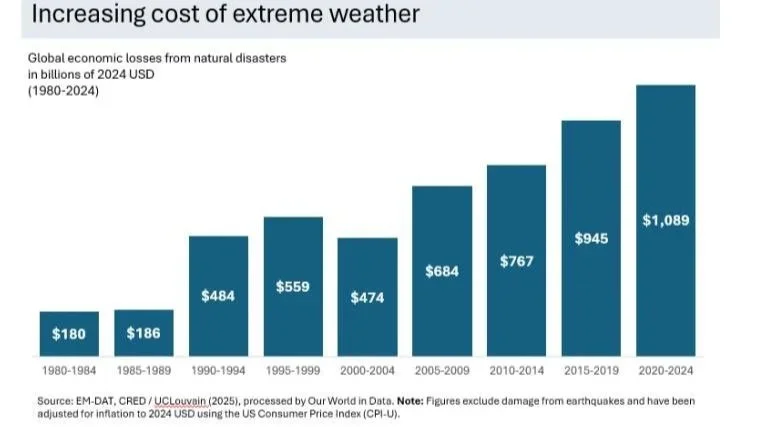
Meanwhile, policy pressure is waning with the rollback of the Inflation Reduction Act (IRA) in the United States and the deregulation movement advancing in the EU with the proposed Omnibus Simplification Package. Competing priorities like AI and tariffs are forcing otherwise environmentally minded leaders to set those values aside for less tumultuous times.
Some things about the trajectory out to 2030 and beyond seem clear: We will continue to breach the Paris Agreement’s 1.5°C global temperature objective, and the costs of extreme events driven by climate change will continue to grow. The need to build resilience for the new and continually changing climate is now more important than ever.
Adaptation yields economic benefits, but what about investor returns?
The economic case for adaptation is well-established. Major assessments, including those by the IPCC and U.S. National Climate Assessment, consistently demonstrate that the value of avoided damages far exceeds the cost of implementation. The Global Commission on Adaptation estimates that a $1.8 trillion investment could yield over $7 trillion in benefits by 2030, while the World Resources Institute finds that resilient infrastructure generates up to $10 in savings for every dollar spent. However, these figures primarily reflect aggregated social and economic benefits—public welfare and avoided losses—rather than private cash flows. The critical question remains: how do these broad economic dividends translate into tangible financial returns for the individual investor?
An increasing body of evidence shows that investing in resilience can indeed yield real financial returns. J.P. Morgan issued a report this year finding that the return on investment ranges from $2 to $43 for every $1 invested in adaptation and resilience. Similarly, research from GIC shows that disaster-related companies outpaced the S&P 500 by about 6.5% per year from 2015 to 2025.
A "Policy-Proof" Asset Class
Adaptation finance is fundamentally different from mitigation finance and is arguably better suited for the current investment landscape. Mitigation investments have been predominantly driven by the need to manage transition risks, often relying on policy incentives (e.g., electric vehicle subsidies) or regulatory penalties (e.g., carbon taxation). As the political landscape shifts, so does the value of pursuing mitigation.
On the other hand, adaptation and resilience finance improves the management of physical risk. While mitigation returns often fluctuate with election cycles and subsidy regimes, adaptation returns are driven by physical realities. For the investor, adaptation offers a form of "policy-proof" growth—a market driven by necessity rather than incentive.
S&P Global estimates that the world’s largest 1,200 publicly traded companies will face up to $1.2 trillion in annual climate-related infrastructure costs by 2050. Investing upfront in resilience allows businesses to reduce the costs associated with these losses or be the "last man standing" in markets too risky for others.
The Moment is Now
Adaptation and resilience is still a nascent investment theme, with many different interpretations of what it means and only a few bold investors actively pursuing it. This suggests there could be an upside that is largely underappreciated in current market projections. In its report, Sizing the Inevitable Investment Opportunity: Climate Adaptation, GIC argues that standard forecasting methods fail to capture how rising heat and extreme weather will accelerate the need for adaptation solutions. For instance, every degree of warming drives new demand for air conditioning, just as intensifying storms increase the necessity for resilient building materials.
Working with Bain & Company, GIC quantified this specific "climate-driven demand" as additional growth on top of current market forecasts across 21 investable solutions. They project the total addressable market will expand from $1 trillion today to $4 trillion by 2050 under a climate scenario where the global average temperature reaches 2.7⁰C above pre-industrial. This kind of climate-driven investible growth is not typically accounted for in industry forecasts.
What should investors and businesses do?
Businesses and investors need to transition from viewing climate adaptation solely as a risk management issue to exploring it as a driver of new business innovation. The market must make room for strategies that deploy core strengths toward new resilience solutions and recognize the value of emerging technologies.
Real-world examples already demonstrate the potential for returns:
Zurich Insurance Group AG developed a standalone unit, Zurich Resilience Solutions (ZRS), which is growing at a compound annual rate of 20%—outpacing the parent company.
The Lightsmith Group, a leading private equity adaptation investor, backs companies like AiDash, which leverages high-resolution satellite imagery and AI to improve operations for critical energy infrastructure.
Tailwind Futures has invested in a diverse range of adaptation firms, including Hohonu (flood sensing), FieldFactors (industrial rainwater harvesting), and Cryogenx (cooling devices for heat-related illnesses).
Wellington Management, a leader in resilience, views water sustainability as a particularly strong investment opportunity.
The investments of firms on the frontlines are charting the way, but significantly more capital is required. Accelerating climate resilience is essential not just for returns, but to secure our supply chains, infrastructure, and communities—keeping businesses running and people healthy through a rapidly changing climate.
Notes:
Global Carbon Project. (2025). https://www.globalcarbonproject.org/
Global Commission on Adaptation. (2019, September 13). Adapt now: a global call for leadership on climate resilience. https://gca.org/reports/adapt-now-a-global-call-for-leadership-on-climate-resilience/
J.P. Morgan. (2025, May 01). Climate Intuition: Unlocking resilience through strategic climate adaptation. https://www.jpmorgan.com/insights/sustainability/climate/unlocking-resilience-through-climate-adaptation
S&P Global. (n.d.). CERAWeek: Physical risk (Special Editorial). https://www.spglobal.com/sustainable1/en/insights/special-editorial/ceraweek-physical-risk
Smith, Niall. (2025, October 15). Does physical climate risk carry a financing premium? Bloomberg Professional Services. https://www.bloomberg.com/professional/insights/sustainable-finance/does-physical-climate-risk-carry-a-financing-premium/
U.S. Chamber of Commerce, Allstate, and U.S. Chamber of Commerce Foundation. (2025, September 04). Beyond the Payoff: How Investments in Resilience and Disaster Preparedness Protect Communities (Resilience Report 2025). https://www.uschamber.com/security/beyond-the-payoff-how-investments-in-resilience-and-disaster-preparedness-protect-communities
Wong De Rui, & Kim Kee Bum. (2025, May 02). Sizing the Inevitable Investment Opportunity: Climate Adaptation. GIC ThinkSpace. https://www.gic.com.sg/thinkspace/sustainability/sizing-the-climate-adaptation-opportunity/
World Resources Institute. (2025, May 29). Strengthening the Investment Case for Climate Adaptation: A Triple Dividend Approach (Working Paper). By Carter Brandon, Bradley Kratzer, Aarushi Aggarwal and Harald Heubaum. https://www.wri.org/research/climate-adaptation-investment-case
